
AI Chatbots vs. Rule-Based DM Automation: Which is Safer for Instagram Growth?
12 minutes read
The Instagram platform will continue to provide more opportunities than ever for businesses to grow and gain attention from new customers in 2025, through direct messages (DMs). Brands, creators, influencers, etc., can use the power of AI technology as a means of lead generation, customer support, and sales for their products and services via the DM channel. No question: while generative AI and large language models (LLMs) together make for smarter bots capable of a far superior conversational experience with users, the definition of smarter could mean different things to different people.
Core Issue
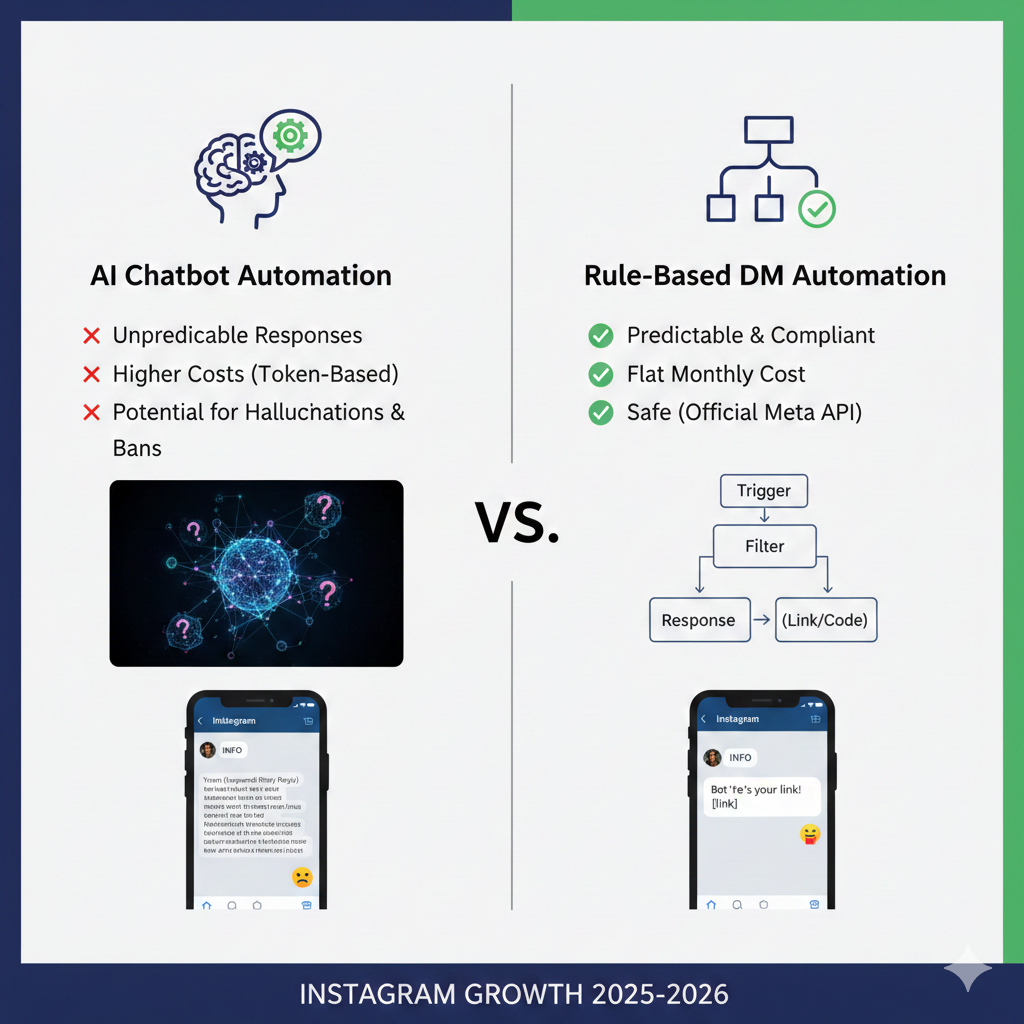
AI chatbots create unpredictability and an increase in your operating expenses, as well as potential harm to both account health and brand reputation. Because chatbots can produce responses that “sound” human, however, they may also create hallucinated responses or inaccurate information, which in turn may cause frustration among customers or more severe consequences. Alternatively, rule-based DM automation generates exactly what is designed: predictable, compliant & instantaneous responses designed to promote conversions (e.g., send links, promo codes, lead magnets).
Rule-based systems deliver extraordinary results when it comes to creating a conversation via DM from comments or providing value quickly. They are safe to use with official Meta tools (the Instagram Graph API), truly predictable, and have tremendous advantages regarding how quickly customers can be converted. The winning sustainable growth strategies of Instagram for 2026 and beyond will focus on the development of simple, reliable form flows.
Chatbot AI Vs. Rule-Based Automation: What is the Difference?
Instagram DM Automation is mainly done in one of two ways: either through the use of rules that are set up to trigger based on certain keywords found in comments or story replies, or by using AI. Rule-based automation uses a set of predefined triggers and responses that can be easily customized to create instant and approved messages (for example: links, coupon codes, and lead magnets). Examples of tools used for this type of automation are Resont, ManyChat, Inrō, and ReplyRush. Resont, for example, leverages Meta’s official Instagram Graph API with built-in delays, randomization, and compliance safeguards. This ensures complete predictability, top-tier security, and virtually zero errors, making it ideal for reliable, high-volume interactions.
By contrast, AI chatbots leverage large language models to generate dynamic, conversational replies in real time, enabling more nuanced and personalized exchanges. While powerful for complex queries, they carry greater risks, including hallucinations (fabricated or inaccurate information), inconsistent brand voice, and potential spam detection triggers. For most brands prioritizing fast, dependable conversions, rule-based automation remains the safer, more controllable, and straightforward choice.
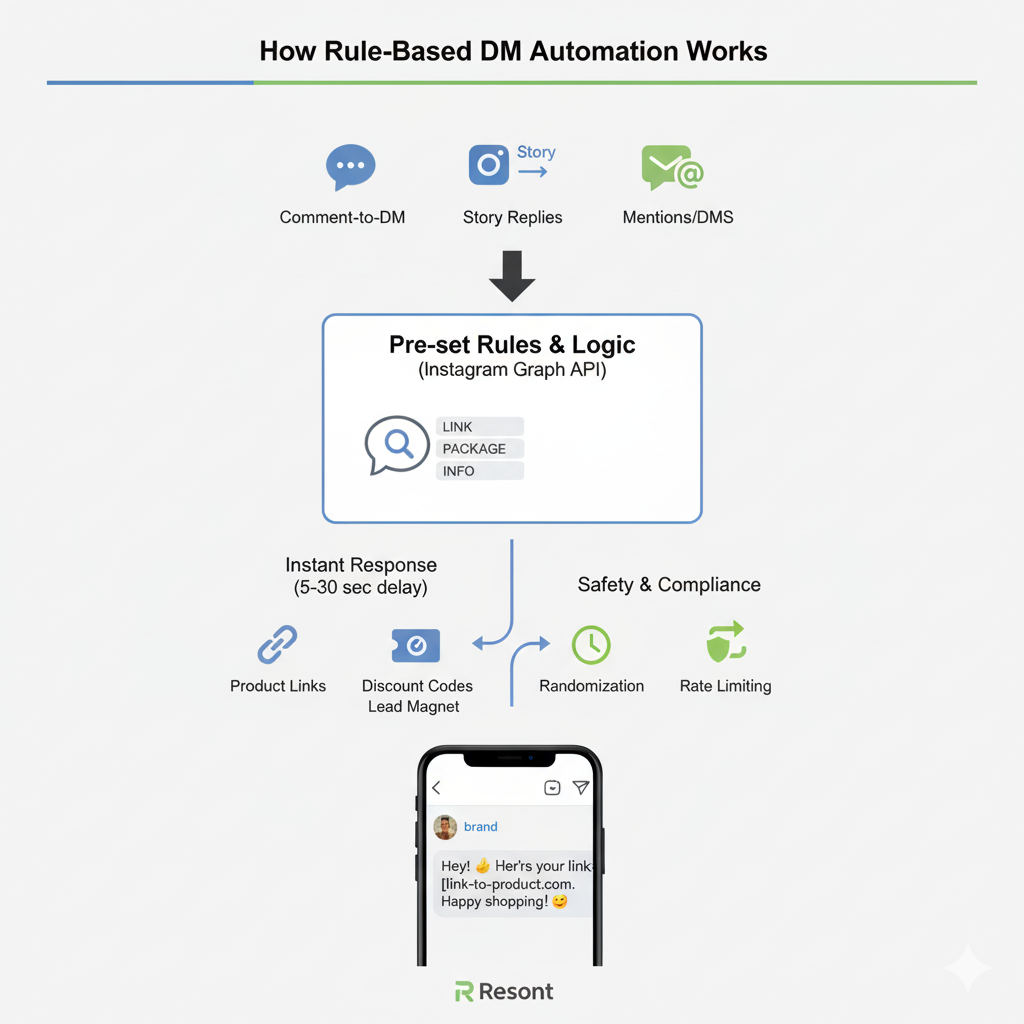
How does Rule-Based Dm Automation work?
Automation of Direct Messages (DM) based on pre-established parameter triggers will incorporate interaction types such as social post responses, including (but not limited to) post messages containing “LINK,” ”PACKAGE,” or “INFO.” Also, story replies, mentions, direct messages, etc.
Once triggered, your scripted responses will go directly to the user almost immediately after the trigger occurs, which will include, but are not limited to, product links, a discount coupon, download of your freebie, and your initial follow-up messages. To help ensure you are compliant with Instagram’s policies and procedures, as well as to appear to be providing genuine personal replies, messages from this automation will include timeframes, variations, and limitations that represent the timeframes and behaviour patterns that humans would typically exhibit when communicating with other users via DM’s.
Automation services such as Resont, ManyChat, Inrō, and RepellyRush are automated systems that can help automate message capitalization decisions from person to automatic via an AI or machine learning program. Resont, an app that provides a range of tools in addition to the Instagram Graph API, which enables you to automate your responses with almost 100% predictability and micropayments.
By creating and approving all automation responses beforehand, you can easily replicate the same level of service regardless of how busy your account becomes. Resont provides an effective way to automate both high-volume automated responses and conversions in response to comments on stories or direct messages.
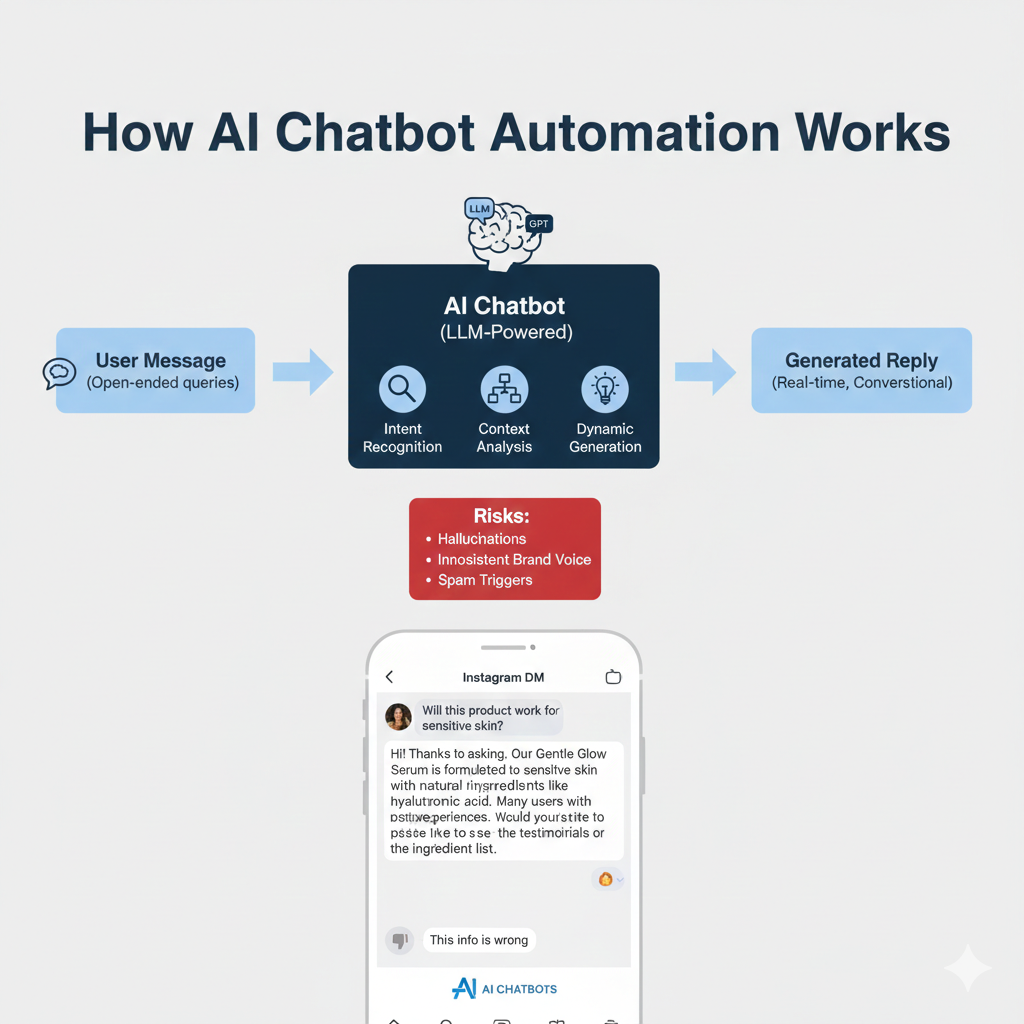
How AI Chatbot Automation Works?
AI chatbot automation uses large language models (LLMs) like those powering GPT to understand user messages, detect intent, and generate original, context-aware responses on the fly.
Instead of fixed templates, the bot analyzes the conversation history and crafts replies that aim to sound natural and engaging, asking clarifying questions, overcoming objections, or building rapport conversationally.
While this enables handling open-ended or complex queries (e.g., “Will this product work for sensitive skin?”), The responses are probabilistic. The model predicts the most likely next words based on patterns in its training data, which means outputs can vary and occasionally deviate from your brand guidelines or factual accuracy.
Platforms like Quidget, TailorTalk, Visito, Inrō, and add-ons in tools like ManyChat integrate generative AI for more dynamic conversations, often with features like intent recognition, personalized recommendations, or seamless human handoff. This makes them powerful for nuanced support or sales qualification, but it also introduces the variability that can lead to hallucinations or inconsistencies.
The 3 Hidden Risks of AI Chatbots on Instagram
AI chatbots may appear very sophisticated, but the use of chatbots has a potential risk that could result in damaging the brand or account of the business due to increasingly stringent anti-spam policies that social media companies are implementing.
1. The “Hallucination” Problem
AI “hallucinations” occur when the AI generates false or falsified data with conviction.
Example: Suppose a customer inquires if there are any recent promotional offers. Rather than providing accurate information, the chatbot generates a fictitious “90% Off Flash Sale” on nonexistent merchandise because it incorrectly takes specific data patterns and extrapolates results. The result is an increase in service escalations, customer complaints, and chargebacks, and eroded consumer confidence in the business.
Real-world precedent: In 2023, the Canadian airline Air Canada faced a jury decision related to an incorrectly stated refund policy following an incident wherein a chatbot provided erroneous information regarding a refund policy. This kind of incident has impacted e-commerce-based businesses that utilize AI for customer service. A rule-based system eliminates this risk because every word is pre-approved by you.

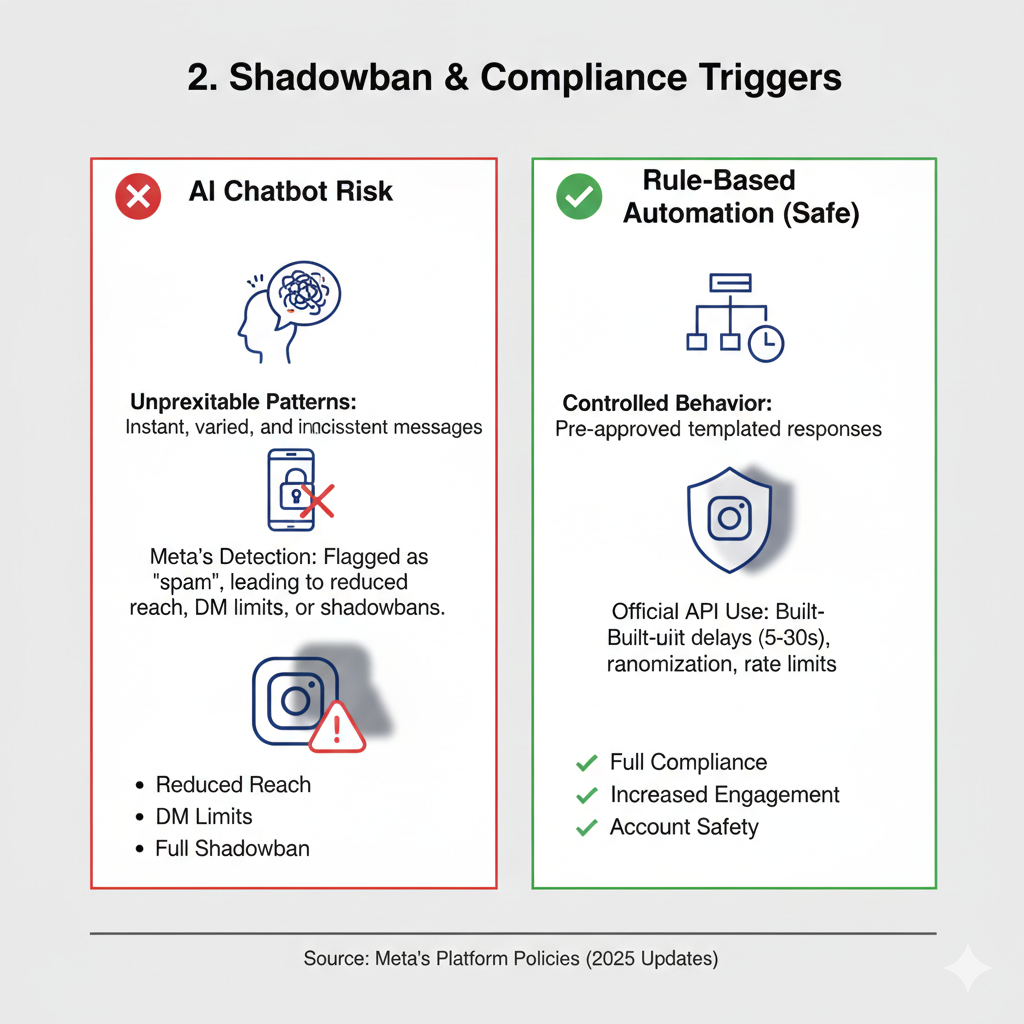
2. Shadowban & Compliance Triggers
Meta’s spam detection algorithms in 2025 will include sophisticated functionality for identifying spam or bots based upon unnatural patterns of behavior, such as instant replies on a mass scale, repeated use of the same phrases, or too many identical types of responses.
Chatbots built using AI will often have detectable characteristics when used without any forethought of the type of interaction being requested by the customer. Inadvertently, chatbots can produce large numbers of unique messages that will result in patterns being displayed.
To date, poorly tuned bots result in an increase in brand-set reach limits on behalf of brands that include DM limits, etc., as well as potentially full shadowbans.
Tools like Resont are designed to use API endpoints for access, provide natural delays (between 5-30 seconds), provide randomization of every message, and apply strict rates consistent with Meta’s guidelines to avoid creating patterns.
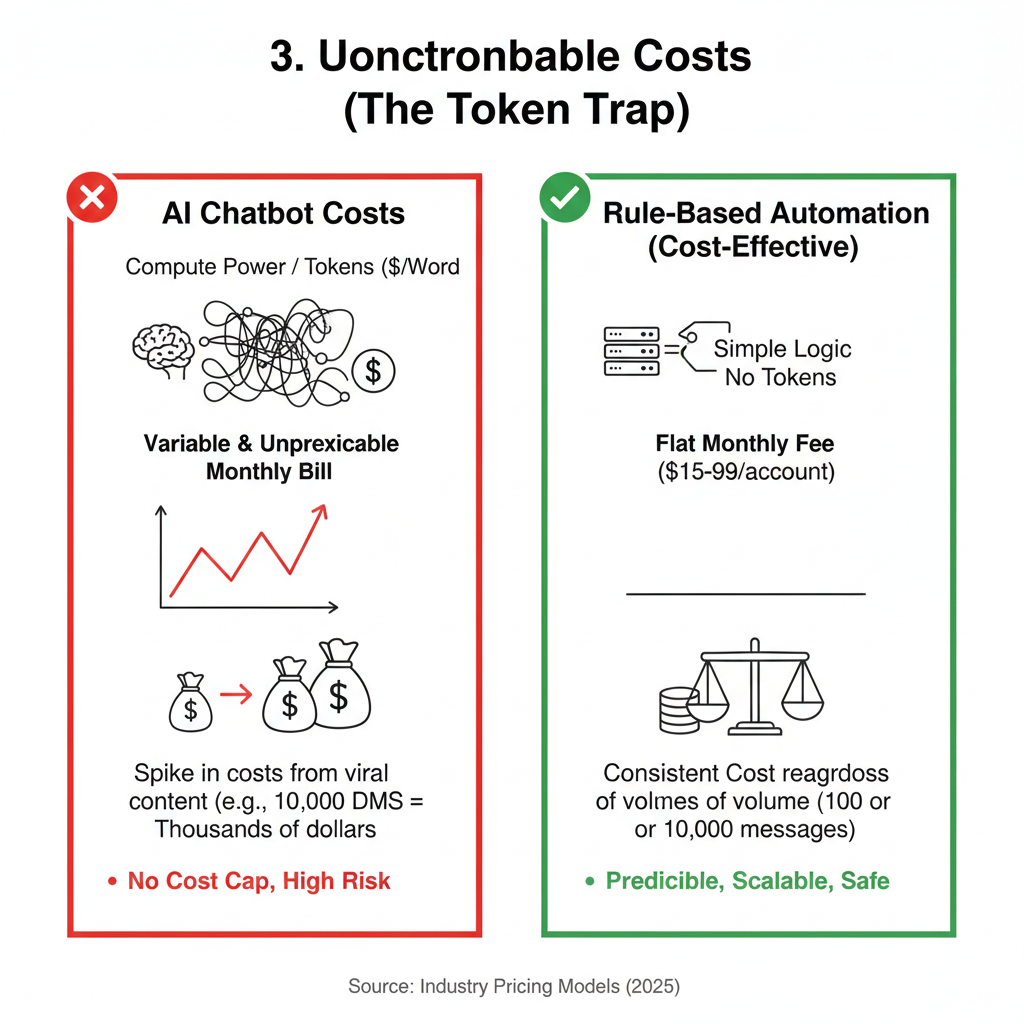
3. Uncontrollable Costs (The Token Trap)
Almost all AI chatbots charge you by token ($/word), which is for both the input and output. Therefore, if you have a viral reel that generates 10,000 dm inquiries, you could end up paying the AI chatbot API (application programming interface) hundreds or thousands of dollars overnight with no cap to the amount!
Conversely, rule-based automation is normally billed at one price for the month (typically $15-$99/account) and doesn’t charge by volume. Rule-Based Automation doesn’t increase your monthly bill regardless of how many messages (100 or 10,000) you send out.
Why Most Brands Prefer Rule-Based Automation for Instagram
Practical data from agencies and growth tools shows a clear trend: brands stick with rule-based for core Instagram funnels. Beyond the risks, there are clear strategic advantages to choosing Rule-Based DM automation for lead generation flows and sales on Instagram.
Speed to Conversion
When Instagram users are in a purchase mindset, they want instant gratification. Users comment “LINK” and respond “INFO” on Instagram because they want the information immediately, not to engage in a lengthy dialogue.
Rule-based flows allow you to send the link or coupon in seconds, resulting in higher conversion rates. Conversely, AI bots tend to prolong the interaction (“Awesome! What size do you need?”), increasing the likelihood that users will abandon their purchase. Research on messaging funnels indicates that the shorter the hierarchy, the more conversions you will receive.
Comparison
AI tries to engage in a conversation, which adds friction and time. Rule-based automation delivers the desired link or information in seconds, streamlining the user journey and increasing conversion rates.
Human Handoff for Complex Queries
The optimal solution is not an “all-or-nothing” approach. An automated system set up with a rules-based approach provides the immediate benefit of delivering value (i.e., fast responses to the repetitive 80% of inquiries), while also allowing nuanced or more emotional inquiries to be forwarded to a live agent through a consolidated inbox.
By doing so, the speed of the messaging system is preserved at times of high volume, and a human touch is only provided to customers when warranted; it also mitigates the risks of using AI during periods of high volume on your accounts.
Hybrid Strategy: The Best of Both Worlds
Top-tier brands include an effective combination of:
Delivery Automation: Utilize rule-based conversations to automate initial engagement through comment-to-DM, story replies, and keyword responses (for instance, via tech such as Resont) to send your offer to the user immediately and in compliance.
Support Personalization: When someone raises a question or presents a challenge that is too complicated or outside the scope of the automated conversation, you will have the ability to route that interaction back to your unified inbox in to deliver a human-crafted or AI-enhanced reply (under the supervision of a human).
Core Ideal: Automate your delivery, but personalize your support.
This strategy allows you to capture leads during their most active state, while remaining completely safe, giving you total control of your costs, and creating a scalable model that maintains trust at all times.
Conclusion
While generative AI-powered chatbots can be useful in certain scenarios within a company’s overall customer service platform, the conditions required for Instagram’s growth through 2026 will necessitate rapid, reliable, and compliant processing, all of which generative AI chatbot technology will likely struggle to provide. An overall cost-benefit justifies the risk versus reward of their use.
By using tools such as Resont that have compliance with Meta’s Graph API to automate DMs, companies can provide a predictable outcome with rock-solid security and superior speed in converting leads. Therefore, even if simple flow-based DM automation may not be as exciting as a generative AI chatbot providing random responses, they produce the same consistent outcome without the unintended consequences of hallucinations, shadowbans, and surprise cost increases.
The current state of the marketplace has produced many positive results for those brands utilizing a blend of speed and compliance instead of relying solely on novelty methods for driving successful growth through Instagram, with simple automation workflows being the most effective solution for creating consistent outcomes.
FAQ:
Q: Is it safe to automate “Comment-to-DM” replies?
A: Yes, but only if you use a tool that utilizes the Official Instagram Graph API. Many “black-hat” tools require your login credentials and mimic a phone’s behavior, which is a guaranteed way to get your account flagged. Rule-based platforms like Resont are official partners; they don’t need your password and operate within Meta’s approved limits. In 2026, this is the only 100% safe way to automate.
Q: Do I need coding skills to set up Rule-Based automation?
A: Not at all. The shift in 2026 has been toward “No-Code” interfaces. Setting up a lead generation flow today is as simple as dragging and dropping boxes in a visual builder. If you can send an email, you can set up a Trigger-based DM automation flow.
Q: Why is Rule-Based automation cheaper than AI chatbots?
A: It comes down to “Compute Power.” AI models (LLMs) charge for the “tokens” or brainpower required to generate a unique response every time. This is expensive and variable. Rule-based automation runs on simple logic that requires very little server energy, allowing platforms to offer a flat monthly fee. This predictability is essential for scaling businesses.
Q: Will using automation cause my engagement to drop or lead to a Shadowban?
A: Paradoxically, correct automation actually increases your engagement. When you respond to a comment instantly via DM, Instagram’s algorithm sees a high “Signal of Interest,” which often pushes your post to the Explore page. A shadowban only occurs if you use unofficial tools or set your bot to reply too fast (e.g., 500 DMs in one minute). Rule-based tools have built-in “Safety Delays” to keep you in the green zone.
Q: Can I still use AI for some things?
A: Absolutely. The best strategy is a Hybrid Model. Use rule-based flows for the initial “hook” (sending links, catalogs, or prices) because it’s fast and safe. Then, use an AI Assistant inside your Unified Inbox to help your human staff draft clever responses to complex questions. The AI helps the human, but the human stays in control.
Q: What happens if a user asks a question my “Rules” don’t cover?
A: This is where the Human Handoff becomes vital. A professional automation setup will have a “Default Reply” or a notification system. If the bot doesn’t recognize a keyword, it can say, “I’m getting a human to help you with that right now!” and instantly alert your team via the Unified Inbox.
Q: Does Instagram allow links in DMs through automation?
A: Yes. In fact, sending links through the Official API is the most effective way to drive traffic. Unlike the “Link in Bio,” which requires three clicks to reach, a DM link is a 1-click conversion. Meta encourages this because it keeps users engaged within the ecosystem while providing a high-quality experience.